Best In-Home Elder Care · Blank Slate Media Award · Serving NYC & Long Island
15+ Years Serving NYC & Long Island Families · 80+ Neighborhoods · NYS Licensed LHCSA
Overnight Care Available 7 Nights Per Week
✓ NYS Licensed LHCSA — licensed by the NY Dept. of Health, not a registry
✓ Every overnight caregiver is our W-2 employee — background-checked, insured, RN-supervised
✓ Serving Manhattan · Brooklyn · Queens · Nassau County · Suffolk County
(516) 408-0034 Available 24 hours a day · 7 days a week · Care typically begins within 24-48 hours
Request a Free Consultation · Verify Our NYS License
Overnight Home Care for Seniors in NYC and Long Island, NY
Overnight Care — At a Glance
- Service Type: Non-medical overnight care by NYS Certified Home Health Aides
- Hours: Typically 8–12 hour overnight shifts · exact hours agreed per care plan
- What It Covers: Nighttime safety supervision · bathroom assistance · fall prevention · dementia wandering supervision · medication reminders · incontinence care · morning personal care · observational reporting
- What It Does Not Cover: Medical diagnosis · skilled nursing · wound care · injections · physical therapy
- Service Territory: Manhattan · Brooklyn · Queens · Nassau County · Suffolk County
- Availability: 7 nights per week · every night of the year
- Pricing: Starting around $330 per overnight shift · see pricing section
- LTC Insurance: 15 carriers accepted · full claims management at no charge
- Supervision: Every caregiver supervised by Registered Nurse
- Care Start: Typically within 24-48 hours
- License: NYS Licensed LHCSA — NY Dept. of Health
Call (516) 408-0034 · Available 24 hours · 7 days a week
Non-Medical Overnight Safety Supervision, Personal Care, and Dementia Support by NYS Certified Home Health Aides — Serving Manhattan, Brooklyn, Queens, Nassau County, and Suffolk County
Quick Answer — What Is Overnight Home Care for Seniors? Overnight home care is non-medical care provided in the home by a NYS Certified Home Health Aide during the nighttime hours — typically an 10-to-12-hour shift covering the period when the risk of falls, disorientation, dementia wandering, and unsupervised nighttime bathroom navigation is highest. The overnight caregiver is present in the home, awake and attentive, providing safety supervision, bathroom assistance, medication reminders, incontinence care, and fall prevention throughout the night — and often providing morning personal care at the beginning of the day shift. Overnight home care differs from live-in care, where a single caregiver stays for extended shifts with scheduled rest periods, and from 24-hour care, where rotating caregivers provide continuous coverage around the clock. All services are non-medical. 7 Day Home Care provides overnight care throughout Manhattan, Brooklyn, Queens, Nassau County, and Suffolk County, seven nights per week. Call (516) 408-0034.
How much does overnight home care cost in NYC and Long Island?
Overnight home care in NYC and Long Island typically starts at approximately $330 per overnight shift. This is a general reference range only — not a pricing guarantee. Long-term care insurance may offset costs significantly. Call (516) 408-0034 for exact pricing based on hours and care plan.
Does Medicare cover overnight home care?
Generally no. Medicare covers physician-ordered skilled home health care — not non-medical overnight care. Most families fund overnight care through private pay or long-term care insurance. See the FAQ below. Call (516) 408-0034.
How quickly can overnight home care begin in NYC or Long Island?
Overnight care typically begins within 24-48 hours. For urgent situations — a post-surgical discharge, a dementia wandering incident, a fall earlier in the week — we work to confirm a caregiver as quickly as same day in many cases. Call (516) 408-0034.
Most families do not think about nighttime until something happens in the dark.
It is the 3 a.m. phone call — the parent who got up to use the bathroom in the Jamaica Estates colonial and fell on the second-floor landing, or the dementia patient in the Prospect Heights brownstone who was found at the front door in the early morning, or the post-surgical client in the Battery Park City high-rise who made it to the bathroom and back but whose daughter in Connecticut could not sleep until 6 a.m. when she knew her mother would be up and safe.
Or it is the call that did not come. The morning when everything was fine but the family understood, for the first time with clarity, that fine was not guaranteed. That the Prospect Heights brownstone staircase does not get safer at midnight. That the post-hip-replacement bathroom transfer does not get easier at 2 a.m. That the dementia patient whose days are structured and calm can become a completely different person after dark.
The nighttime hours — roughly 9 p.m. to 7 a.m., the specific span that varies by the client's routine and the care plan — are statistically the highest-risk period in home care. Falls are more likely. Disorientation is more common. Medication errors are more frequent. The bathroom trip that goes smoothly at noon becomes the fall that changes everything at 3 a.m.
Overnight home care is the professional, non-medical answer to that specific risk window. A trained NYS Certified Home Health Aide is present in the home, attentive throughout the night, providing safety supervision, bathroom assistance, fall prevention, dementia wandering supervision, incontinence care, and medication reminders — so that the family in Connecticut or Manhattan or Nassau County can sleep knowing that someone they trust is present where it matters, when it matters.
At 7 Day Home Care, every overnight caregiver is our W-2 employee — background-checked, insured, and supervised by our Registered Nurse. They are not placed from a registry. They are trained professionals whose overnight assignment includes a briefing on the specific layout of this home, the specific condition of this client, and the specific nighttime risk protocol that the RN assessment developed before their first shift.
We provide overnight care throughout Manhattan, Brooklyn, Queens, Nassau County, and Suffolk County, seven nights per week — including weekends, holidays, and the nights that arrive without warning.
Call (516) 408-0034 · Available 24 hours a day · 7 days a week
What Is the Difference Between Overnight Care, Live-In Care, and 24-Hour Care?
Quick Answer — Overnight Care vs. Live-In Care vs. 24-Hour Care: What Is the Difference? Overnight care covers a specific nighttime shift — typically 10 to 12 hours — during which the caregiver is awake, attentive, and providing active supervision and assistance throughout the night. Live-in care means a single caregiver stays in the home for extended shifts with scheduled rest periods — appropriate when the need is continuous presence over a longer period rather than active supervision through a specific high-risk overnight window. 24-hour care means rotating caregivers provide continuous awake coverage around the clock — appropriate for advanced dementia, significant fall risk, or conditions requiring continuous supervision. Call (516) 408-0034 to discuss which structure fits your specific situation.
Overnight Care
An overnight caregiver works a defined nighttime shift — most commonly arriving between 8 and 9 p.m. and departing between 7 and 9 a.m. During the shift, the caregiver is awake and attentive. They are not sleeping. They monitor the client throughout the night, respond to any nighttime need — bathroom assistance, repositioning, incontinence care, fall prevention, dementia redirection — and often provide morning personal care at the beginning of the following day. Overnight care is the right structure when the primary risk is nighttime-specific: post-surgical bathroom navigation, dementia wandering, nighttime fall risk, or the family's inability to be present during the nighttime hours.
Live-In Care
A live-in caregiver stays in the home for extended shifts — typically 24-hour periods with scheduled rest breaks — and requires sleeping accommodations in the client's home. The live-in structure provides continuous presence over a longer period and is appropriate for clients who need consistent daily and nightly support but whose needs during the night do not require an awake, attentive caregiver throughout all nighttime hours. Live-in care and overnight care address different versions of the same need. Learn more: See our full service pages for context on live-in and 24-hour arrangements.
24-Hour Care
Rotating caregivers provide continuous awake coverage through the full 24-hour day. Appropriate for advanced dementia, significant continuous fall risk, or conditions requiring uninterrupted supervision. 24-hour care is the highest level of non-medical home care and is structured as two or three caregiver shifts per 24-hour period to ensure continuous alertness. Call (516) 408-0034 to discuss whether overnight, live-in, or 24-hour care fits the specific situation.
Who Needs Overnight Home Care?
Quick Answer — Who Needs Overnight Home Care for Seniors? Overnight home care is for older adults whose primary risk is concentrated in the nighttime hours — post-surgical clients navigating a home bathroom or staircase during early recovery, dementia and Alzheimer's patients who become disoriented or wander after dark, Parkinson's patients whose nighttime mobility is a daily family anxiety, post-stroke clients in the weeks immediately following discharge, and older adults living alone whose families cannot be present during the night. Overnight care is also the right structure for families providing daytime care themselves but who need reliable, professional nighttime coverage so they can sleep.
Overnight home care is typically the right solution when:
- A parent has been discharged from a hospital or rehabilitation facility — from NYU Langone Long Island, from NYP Brooklyn Methodist, from Jamaica Hospital, from Margaret Tietz — and is returning to a Prospect Heights brownstone or a Jamaica Estates Tudor Revival or a Manhasset colonial whose interior staircase or bathroom requires supervised navigation during early post-surgical recovery, including at 3 a.m.
- A parent with Alzheimer's or dementia becomes disoriented or attempts to leave the home after dark — a pattern that is common, dangerous in any New York City or Long Island residential environment, and entirely manageable with professional overnight supervision.
- A parent with Parkinson's disease has a nighttime bathroom navigation pattern that has become the family's daily anxiety — the freezing at the bedroom door, the transfer from the bed, the narrow bathroom in the Forest Hills apartment.
- A family member has been providing daytime care reliably but cannot provide nighttime coverage — and the gap between when the family member goes home and when they return in the morning is the specific window of risk that overnight care covers.
- A parent is living alone in a Battery Park City high-rise or a Queens single-family home or a Nassau County ranch and the family's only reliable reassurance would be knowing that a professional is present in the home from 10 p.m. to 7 a.m.
What Does an Overnight Caregiver Actually Do?
Quick Answer — What Does an Overnight Caregiver Do During the Night Shift? A 7 Day Home Care overnight caregiver arrives at the agreed time, receives a briefing from the day caregiver or family member on the client's current status and any changes from the day, maintains awake and attentive supervision throughout the nighttime hours, assists with bathroom trips, provides fall prevention and safe transfer support, manages incontinence care as needed, redirects dementia patients who become disoriented or attempt to leave the home, provides medication reminders at any scheduled nighttime times, and often provides morning personal care — bathing, dressing, breakfast preparation — at the start of the day shift. All changes in the client's nighttime status are observed and reported to the 7 Day Home Care Registered Nurse and to the family.
Nighttime Safety Supervision and Fall Prevention
The overnight caregiver is the specific professional presence that prevents the event families fear most — the 3 a.m. fall in the bathroom, the disoriented patient who gets up in the dark and does not make it to the wall. In a Prospect Heights brownstone with its narrow bathroom and steep interior staircase, the nighttime fall risk is concentrated in the specific fifteen-foot path between the bedroom and the bathroom. In a Jamaica Estates Tudor Revival with its second-floor bedroom, it is the staircase landing. In a Battery Park City condominium with wide hallways and elevator access, the bathroom configuration is the primary risk. The overnight caregiver knows the specific layout of this home before their first shift — because the RN assessment documented it and the pre-shift briefing confirmed it.
Bathroom Assistance
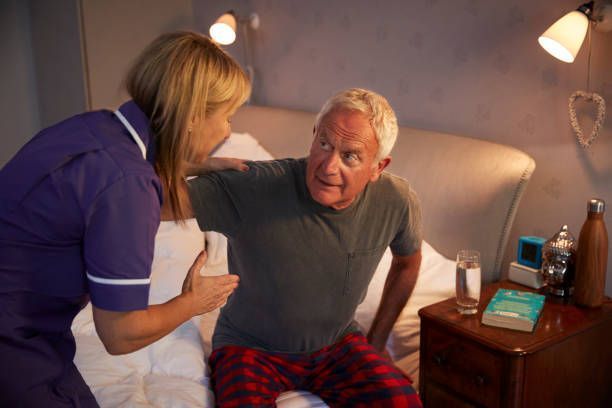
Safe nighttime toilet transfers — the move from the bed to standing to the bathroom and back — are the highest-risk physical sequence in the overnight window for post-surgical and neurologically impaired clients. The overnight caregiver provides the specific physical support and transfer assistance that the day caregiver's protocol established, consistently and without exception, on every bathroom trip throughout the night. The bathroom trip at 3 a.m. receives the same professional attention as the bathroom trip at 3 p.m.
Dementia and Alzheimer's Overnight Supervision
For clients with Alzheimer's or dementia, the overnight hours introduce a specific set of risks: sundowning — the late-afternoon and evening increase in confusion, agitation, and disorientation that is common in dementia — and nocturnal wandering, the pattern of leaving the bed, attempting to exit the home, or becoming lost within it during the nighttime hours. The overnight caregiver is trained in dementia redirection — the specific non-confrontational response that calms a disoriented client and safely returns them to bed without increasing agitation. For a dementia patient in a Queens single-family home or a Brooklyn brownstone or a Nassau County colonial, the overnight caregiver is the specific barrier between the client and the front door at 2 a.m. Language-matched caregiver assignment for dementia clients whose primary language is Hindi, Haitian Creole, Russian, Mandarin, or another language is confirmed before the overnight arrangement begins.
Parkinson's Disease Overnight Protocol
Parkinson's disease creates specific overnight challenges: rigidity that increases during periods of inactivity, difficulty initiating movement after lying still for several hours, and freezing of gait at the bedroom door or bathroom threshold — the enclosed transition that is the most common Parkinson's freezing trigger in the home environment. The overnight caregiver for a Parkinson's patient is briefed on the specific cueing strategies and movement initiation techniques that the RN assessment and the occupational therapy discharge notes establish. The 3 a.m. bathroom trip for a Parkinson's patient in a Forest Hills apartment or a Bayside colonial is not the same as the bathroom trip for a post-surgical patient — and the overnight protocol reflects that difference.
Medication Reminders
For clients with nighttime medication schedules, the overnight caregiver provides non-medical medication reminders at the scheduled times — confirming that the client has taken scheduled medications. They do not administer medications, adjust dosages, or provide clinical oversight. This is a non-medical function performed at the direction of the family and care team.
Morning Personal Care
Many overnight care arrangements include morning personal care at the end of the shift — bathing or shower assistance, dressing, grooming, and breakfast preparation before the overnight caregiver departs. This ensures continuity between the overnight shift and the start of the day, whether the day is managed by a day caregiver, a family member, or the client independently.
Observational Reporting
Every change in the client's nighttime status — a fall, an incontinence event, a significant episode of disorientation, a change in breathing or skin condition or sleep pattern — is observed and reported to the 7 Day Home Care Registered Nurse and to the family. The overnight caregiver is often the first professional to observe changes that indicate a developing health issue. The RN evaluates reports and responds as clinically appropriate. The overnight caregiver observes and reports. The Registered Nurse assesses and directs.
Non-Medical Overnight Care Services — Full List
- Overnight safety supervision — 10 to 12 hour shifts, 7 nights per week
- Nighttime bathroom assistance and safe toilet transfers
- Fall prevention and nighttime mobility support
- Dementia and Alzheimer's wandering supervision and redirection
- Parkinson's disease nighttime movement support and cueing Incontinence care and management
- Medication reminders at scheduled nighttime times (non-medical)
- Repositioning and comfort care for bedbound or limited-mobility clients
- Morning personal care at shift end — bathing, dressing, breakfast
- Observational reporting to RN care team and family
- Multilingual overnight care — see language list below
Caregiver Languages: English · Spanish · Mandarin · Cantonese · Hindi · Urdu · Bengali · Punjabi · Haitian Creole · Russian · Hebrew · Yiddish · Tagalog · Arabic · Italian · French · Portuguese · more
Backup Coverage: In the rare event a scheduled overnight caregiver cannot arrive, 7 Day Home Care arranges a qualified replacement. Overnight shifts are not left uncovered.
All services are non-medical. 7 Day Home Care does not provide medical diagnosis, treatment, skilled nursing, or clinical home health services.
A Family That Stopped Waiting for the Next Fall
A family in Forest Hills contacted us about their father, who was eighty years old and had been managing his Parkinson's disease — diagnosed six years earlier — with increasing difficulty in his three-bedroom apartment on Ascan Avenue. The daytime hours were structured: a day caregiver four days a week, the family present on weekends, his daughter managing Monday and Friday morning routines before her own work day.
The nighttime was different. His bedroom was at the far end of the hallway from the bathroom. The hallway was eight feet long and the bathroom door was a standard interior door — an enclosed transition that triggered freezing episodes consistently when he navigated it alone. He had fallen twice in the previous three months, both times at night, both times on the way to or from the bathroom. Neither fall resulted in a hospitalization. Both of them resulted in his daughter lying awake in her apartment in Kew Gardens until 7 a.m. each morning.
She called us after the second fall.
We conducted the RN home assessment of the Ascan Avenue apartment — specifically the bedroom-to-bathroom hallway, the bathroom door threshold, the toilet transfer configuration, and the specific freezing pattern documented by his neurologist. We developed an overnight protocol: specific cueing sequences at the bedroom door and the bathroom threshold, the physical support positioning for the toilet transfer, and the return-to-bed sequence. The caregiver spoke English and Spanish fluently — not his primary language, but sufficient for the overnight direction he needed.
His daughter asked us one question on the follow-up call: "Does he know someone is there?"
He does. He has told her so.
She sleeps through the night now. He has not fallen since the overnight arrangement began.
Details modified for privacy.
— Ready to discuss overnight care for your family? — Call (516) 408-0034 · Available 24 hours a day · 7 days a week · Care typically begins within 24-48 hours Request a Free Consultation
Overnight Care After Hospital or Rehabilitation Discharge
Quick Answer — How Does Overnight Care Work After a Hospital or Rehab Discharge? The nighttime hours immediately following a hospital or rehabilitation discharge are the highest-risk period of the entire recovery. Post-surgical clients are at peak bathroom transfer risk in the first two to four weeks at home. Nighttime bathroom navigation — in the dark, with reduced alertness, through the specific layout of a home that may not have been assessed for post-surgical safety — is when the fall that reverses the recovery most commonly occurs. For clients returning to a Prospect Heights brownstone, a Jamaica Estates colonial, a Manhasset ranch, or a Battery Park City high-rise, 7 Day Home Care coordinates overnight care with the hospital or rehabilitation facility's discharge team. We receive discharge notes, conduct the RN home assessment before discharge day, and have the overnight caregiver briefed and confirmed before the first night home.
Hospitals and rehabilitation facilities whose discharge teams we coordinate with include:
NYU Langone Hospital — Long Island · Mineola, Nassau County North Shore University Hospital · Manhasset, Nassau County NewYork-Presbyterian Brooklyn Methodist Hospital · Park Slope, Brooklyn Long Island Jewish Forest Hills — Northwell Health · Forest Hills, Queens Jamaica Hospital Medical Center · Jamaica, Queens Huntington Hospital — Northwell Health · Huntington, Suffolk County Margaret Tietz Nursing and Rehabilitation Center · Jamaica, Queens Downtown Brooklyn Nursing and Rehabilitation Center · Brooklyn New Carlton Rehabilitation and Nursing Center · Brooklyn Parker Jewish Institute · New Hyde Park, Nassau County
Overnight Care and Long-Term Care Insurance
Quick Answer — Does Long-Term Care Insurance Cover Overnight Home Care? Yes, in most cases. Most long-term care insurance policies cover non-medical overnight care when provided by a licensed LHCSA. 7 Day Home Care manages benefit verification, claims submission, and all ongoing documentation at no charge. Call (516) 408-0034 to verify your specific policy.
CNA · Brighthouse · Genworth · Mutual of Omaha · MetLife · Transamerica · John Hancock · New York Life · Northwestern Mutual · MassMutual · Lincoln Benefit Life · UNUM · Bankers Life
ADL threshold: Most long-term care insurance policies define benefit eligibility as requiring assistance with two or more Activities of Daily Living. For clients requiring overnight bathroom assistance and transfer support, the bathing and transferring ADL criteria are typically met. If your parent requires nighttime toilet transfer assistance and morning bathing support, in most cases their policy's benefit eligibility condition has been met. Call (516) 408-0034 before making assumptions about coverage.
Elimination periods: Most policies include an elimination period — typically 30, 60, or 90 days — during which qualifying care must be received before ongoing benefits begin. Overnight care from a licensed LHCSA counts toward satisfying the elimination period from the first night of service. Starting overnight care immediately following a hospital or rehabilitation discharge begins the clock immediately.
What Does Overnight Home Care Cost in NYC and Long Island?
Quick Answer — How Much Does Overnight Home Care Cost in New York? Overnight home care in NYC and Long Island typically starts at approximately $330 per overnight shift. This is a general reference range only — not a guarantee. Long-term care insurance may offset the majority of costs for eligible clients. Families combining overnight care with daytime hourly or live-in care should call to discuss combined scheduling and rates. Call (516) 408-0034 for a personalized consultation.
Overnight Care — starting around $330 per shift
General reference range only — not a pricing guarantee. Call (516) 408-0034.
Medicare generally does not cover non-medical overnight home care. Medicaid may cover certain home care services for eligible individuals. Long-term care insurance policies from the carriers listed above typically cover overnight care when provided by a licensed LHCSA.
— Want exact pricing for your specific situation? — Call (516) 408-0034 · Available 24 hours a day · 7 days a week Request a Free Consultation
When Do Families Arrange Overnight Home Care?
Families typically contact us about overnight care when a specific nighttime event — or the accumulating weight of nighttime anxiety — makes the need undeniable.
Families often describe noticing or experiencing:
- A nighttime fall — in the bathroom, on the interior staircase, on the way back to bed — that resulted in a hospitalization or that the family found out about the next morning when the parent mentioned it carefully, minimizing its seriousness
- A post-surgical discharge with a nighttime bathroom transfer requirement the family cannot consistently cover — the parent returning to a Prospect Heights brownstone or Jamaica Estates Tudor or Manhasset colonial whose overnight bathroom path is the specific risk the discharge planner flagged
- A dementia wandering episode after dark — the patient found at the front door, or found in a different room, or found having left the building — that made clear that unmonitored nighttime hours are no longer safe
- The family member who has been providing overnight coverage — sleeping on the couch, listening for every sound, waking at 2 a.m. every night — who has reached the physical and emotional limit of sustainable overnight caregiving
- The parent with Parkinson's disease whose nighttime bathroom navigation has become the organizing daily anxiety of the adult child who lives thirty minutes away
- The discovery that a long-term care insurance policy covers overnight care and that the overnight need their parent has been living with for months was fundable all along
Frequently Asked Questions About Overnight Home Care in NYC and Long Island
What is overnight home care for seniors?
Overnight home care is non-medical care provided by a NYS Certified Home Health Aide during the nighttime hours — typically an 10-to-12-hour shift covering the period of highest fall risk, disorientation, and dementia wandering. The overnight caregiver is present, awake, and attentive throughout the shift, providing safety supervision, bathroom assistance, fall prevention, dementia redirection, incontinence care, medication reminders, and morning personal care. All services are non-medical. Call (516) 408-0034.
What is the difference between overnight care, live-in care, and 24-hour care?
Overnight care covers a specific nighttime shift during which the caregiver is awake and actively supervising. Live-in care means a single caregiver stays in the home for extended shifts with scheduled rest periods. 24-hour care means rotating caregivers provide continuous awake coverage through the full day and night. Call (516) 408-0034 to discuss which structure fits your specific situation.
How much does overnight home care cost in New York?
Overnight home care in NYC and Long Island typically starts at approximately $330 per overnight shift. General reference range only — not a guarantee. Long-term care insurance may offset costs significantly. Call (516) 408-0034 for exact pricing.
Does Medicare cover overnight home care?
Generally no. Medicare covers physician-ordered skilled home health care — not non-medical overnight care. Non-medical overnight care is funded through private pay or long-term care insurance.
Does long-term care insurance cover overnight home care?
In most cases, yes. Most long-term care insurance policies cover non-medical overnight care when provided by a licensed LHCSA. 7 Day Home Care manages benefit verification, claims submission, and ongoing documentation at no charge for all 15 carriers. Call (516) 408-0034 to verify your specific policy.
Does overnight care count toward satisfying a long-term care insurance elimination period?
In most cases, yes. Overnight care from a licensed LHCSA counts toward satisfying the elimination period — typically 30, 60, or 90 days — from the first night of service. Call (516) 408-0034 before making assumptions about your timeline.
Is the overnight caregiver awake or sleeping?
The overnight caregiver is awake and attentive throughout the shift. Overnight care at 7 Day Home Care is active supervision — not a sleeping-in arrangement where the caregiver rests and responds only when called. The caregiver monitors the client throughout the night and provides assistance whenever needed.
Who needs overnight home care?
Overnight care is for post-surgical clients in early home recovery, dementia and Alzheimer's patients who become disoriented or wander after dark, Parkinson's patients with nighttime mobility challenges, older adults living alone whose families cannot provide nighttime coverage, and family members who have been providing overnight care themselves and need professional relief. Call (516) 408-0034.
Does 7 Day Home Care provide overnight care for dementia patients?
Yes. Our overnight caregivers are trained in dementia overnight supervision — including sundowning management, nocturnal wandering redirection, and the non-confrontational response techniques that calm a disoriented client and safely return them to bed. Language-matched caregiver assignment for dementia clients is confirmed before the overnight arrangement begins. Call (516) 408-0034.
How quickly can overnight care begin?
Overnight care typically begins within 24-48 hours. For urgent situations — a fall earlier in the week, a post-surgical discharge, a dementia wandering incident — we work to confirm a caregiver as quickly as same day in many cases. Call (516) 408-0034.
Does 7 Day Home Care provide overnight care after a hospital or rehabilitation discharge?
Yes. For clients returning home from a hospital or rehabilitation facility, we coordinate overnight care with the discharge planning team before the client leaves — receiving discharge notes, conducting the RN home assessment of the specific home before discharge day, and having the overnight caregiver briefed and confirmed before the first night home. The first night back in the Jamaica Estates Tudor Revival or the Manhasset colonial or the Prospect Heights brownstone is managed by a prepared professional. Call (516) 408-0034.
What is a licensed LHCSA and why does it matter for overnight care?
A Licensed Home Care Services Agency (LHCSA) is licensed by the New York State Department of Health to employ, credential, and RN-supervise caregivers. Most long-term care insurance policies require overnight care to be provided by a licensed LHCSA for benefits to apply. A caregiver registry places independent contractors without the employment, insurance, and supervision obligations of a licensed agency. 7 Day Home Care is a licensed LHCSA. Every overnight caregiver is our W-2 employee.
Do overnight caregivers speak languages other than English?
Yes. Our overnight caregiver team includes speakers of Spanish, Mandarin, Cantonese, Hindi, Urdu, Bengali, Punjabi, Haitian Creole, Russian, Hebrew, Yiddish, Tagalog, Arabic, Italian, French, Portuguese, and additional languages. For dementia patients whose first language becomes the dominant communication channel as cognitive decline progresses, language-matched overnight caregiver assignment is a care priority. Please specify language requirements when you call (516) 408-0034.
What happens if a scheduled overnight caregiver cannot arrive?
7 Day Home Care arranges a qualified replacement. Overnight shifts are not left uncovered. This is the specific operational commitment of being a licensed LHCSA employer rather than a registry, where overnight coverage gaps fall to the family to resolve — often at 8 or 9 p.m. on a Tuesday.
Can overnight care be combined with daytime hourly or live-in care?
Yes. Many families combine overnight care with daytime hourly personal care or companion care — overnight coverage from 8 p.m. to 8 a.m. and daytime coverage for some or all of the remaining hours. 7 Day Home Care coordinates the full care schedule across overnight and daytime shifts. Call (516) 408-0034 to discuss a combined arrangement. 7 Day Home Care arranges a qualified replacement. Overnight shifts are not left uncovered. This is the specific operational commitment of being a licensed LHCSA employer rather than a registry, where overnight coverage gaps fall to the family to resolve — often at 10 p.m. on a Tuesday.
Overnight Home Care Serving Manhattan, Brooklyn, Queens, Nassau County, and Suffolk County
7 Day Home Care provides overnight care throughout the following communities, seven nights per week. Select a location for neighborhood-specific care information.
Manhattan Battery Park City · Financial District · Tribeca · Greenwich Village · SoHo · NoHo · Chelsea · Gramercy · Midtown · Hudson Yards · Upper East Side · Lenox Hill · Carnegie Hill · Upper West Side
Brooklyn Prospect Heights · Brooklyn Heights · Park Slope · Carroll Gardens · Cobble Hill · Boerum Hill · DUMBO · Williamsburg · Fort Greene · Vinegar Hill · Gowanus · Red Hook
Queens Jamaica Estates · Flushing · Forest Hills · Fresh Meadows · Bayside · Astoria · Beechhurst · Ditmars Steinway · Kew Gardens · Little Neck · Douglaston · Whitestone · College Point · Long Island City · Belle Harbor · Neponsit · Rockwood Park · Glen Oaks
Nassau County Great Neck · Manhasset · Old Westbury · Garden City · Roslyn · Floral Park · Williston Park · Port Washington · Valley Stream · Woodmere · Baldwin · Oyster Bay · Jericho · Syosset · Plainview · Massapequa
Suffolk County Huntington · Melville
All Service Areas — NYC and Long Island
Explore Other 7 Day Home Care Services
Home Health Aide — Personal Care Services
Licensed. Supervised. Responsive.
7 Day Home Care is a New York State licensed LHCSA (Licensed Home Care Services Agency), licensed by the New York State Department of Health to provide non-medical overnight care and home health aide services throughout Manhattan, Brooklyn, Queens, Nassau County, and Suffolk County.
Every overnight caregiver is a NYS Certified Home Health Aide — our W-2 employee, background-checked, insured, and supervised by our Registered Nurse. We do not use registries or referral platforms. We do not staff aides who are not credentialed. All services are non-medical.
Our overnight caregivers speak English, Spanish, Mandarin, Cantonese, Hindi, Urdu, Bengali, Punjabi, Haitian Creole, Russian, Hebrew, Yiddish, Tagalog, Arabic, Italian, French, Portuguese, and additional languages.
For emergencies, call 911.
Main: (516) 408-0034
3000 Marcus Avenue
Lake Success, NY 11042
By Appointment · Serving Nassau County, Suffolk County, and Queens
Get Directions — Long Island Office
100 Park Avenue, Suite 1600
New York, NY 10017
By Appointment · Serving Manhattan, and Brooklyn
Get Directions — Manhattan Office
Open 24 Hours a Day · 7 Days a Week
The Night That Changes Everything Doesn't Announce Itself
The families who arrange overnight care before the second fall are the ones who made a decision based on what they understood rather than what had already happened. The parent in the Forest Hills apartment who has navigated the hallway bathroom alone at 3 a.m. three hundred times and will do it successfully three hundred and one times — until the night he does not.
Overnight care does not wait for the fall. It prevents it.
"Does he know someone is there? He does. He has told me so. And I sleep now. That's what I needed."
Call (516) 408-0034 Available 24 hours · 7 days a week · Care typically begins within 24-48 hours
Home Health Aide — Personal Care Services
© 2026 7 Day Home Care Ltd. All rights reserved. Licensed by the New York State Department of Health. Serving Manhattan · Brooklyn · Queens · Nassau County · Suffolk County Last updated April 2026.